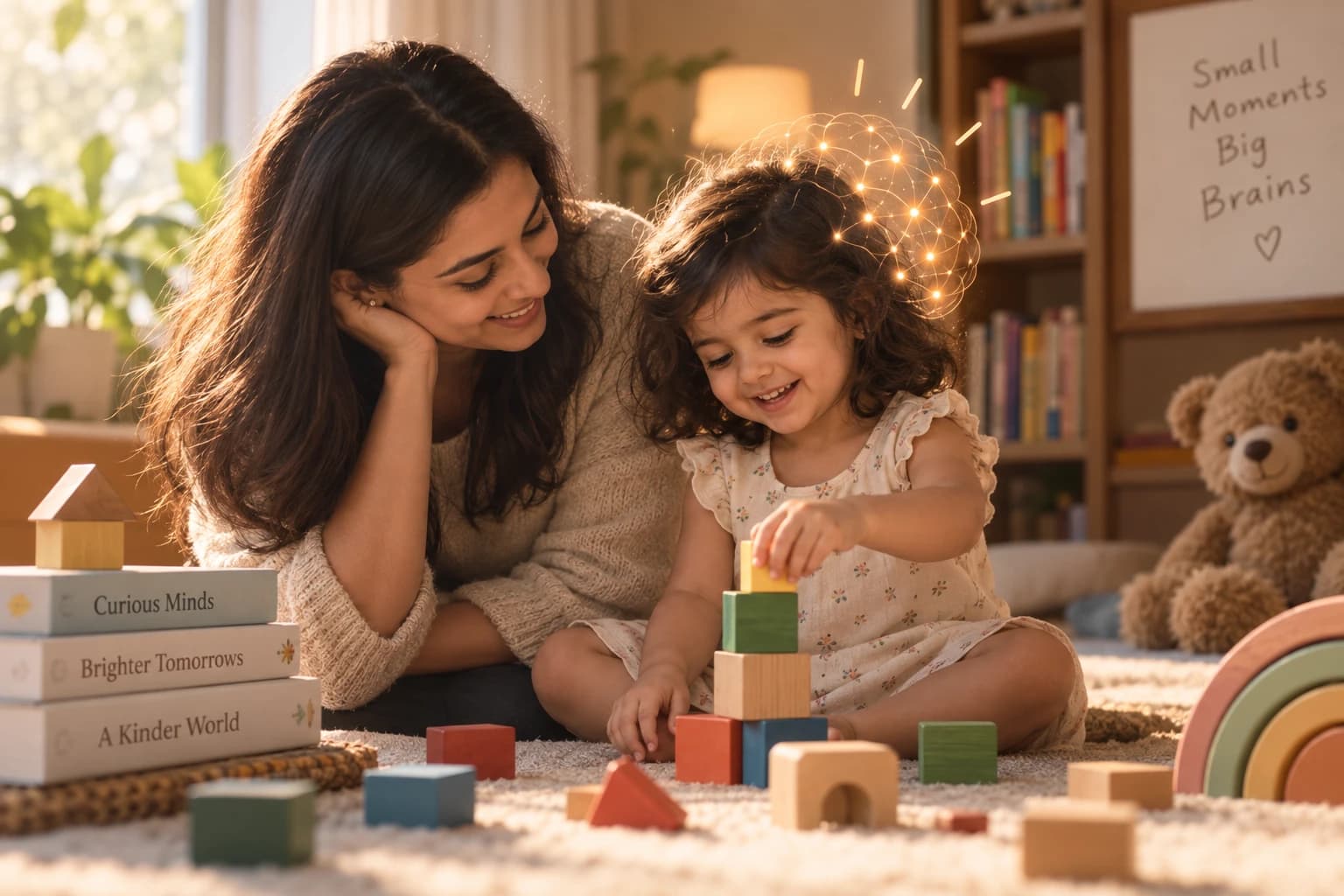



Of everything published about early childhood, this is the finding with the best ratio of importance to cost. It requires no equipment, no app and no money, and it is the mechanism underneath most of the advice you have already been given.
What it actually is
Harvard's Center on the Developing Child calls it serve and return. The child serves — a cry, a babble, a gesture, a look held a second too long. The adult returns: eye contact, words back, peekaboo, passing the toy. These responsive back-and-forth exchanges shape brain architecture, and the Center's summary is blunt about the stakes: the human brain expects this game of back and forth, and it is essential for healthy development.
notice the serve · return it · name what it is · take turns and wait · practise endings and beginnings
Harvard CDC — 5 Steps for Brain-Building Serve and Return
Play one rally
0 returnsNotice that the adult never changes the subject, and the rally ends when the child ends it. That is the whole technique.
Why it beats simply talking a lot
There is a useful distinction here. A 2019 study run by the New York State Psychiatric Institute and Columbia University found that the number of back-and-forth interactions mattered for children’s language development — and that children who took part in more serve-and-return exchanges showed greater activity in the relevant brain areas than children who had simply heard a lot of words. Volume of speech is not the active ingredient. Contingency is: the answer has to be to them, and it has to arrive while they are still interested.
Naming is the other half. Saying what a child is seeing, doing or feeling builds language connections before they can talk or understand the words — which is why narrating the pouring of water beats saying careful.
What happens when it is missing
The Center describes the persistent absence of serve-and-return as a double whammy: the brain does not get the stimulation it needs, and the body’s stress response is activated. The word persistent is doing real work in that sentence. No parent returns every serve, and no child needs them to. What the research warns about is the chronic version, usually driven by circumstance rather than indifference.
The same skill, in a classroom
This is exactly what a trained pre-primary teacher is doing when a room looks calm: fifteen children, a hundred serves an hour, and an adult returning as many of them as she can while keeping the day moving. It is the least visible and most skilled part of the job — and it is the part a parent has already had years of practice at.
- Follow, do not lead. Return the serve they made rather than the one you would prefer. The topic is the child’s to choose.
- Wait longer than is comfortable. The pause after your return is where the child assembles a reply. Filling it ends the rally.
- Let them end it. Attention finishes before you expect it to. Noticing the end is part of the skill, not a failure of it.